

There’s a café called “The Bloc 145” and a bakery called “Breadfern” sitting just up the road from what was formerly known as The Block, a once iconic residential block of housing in the inner-city suburb of Redfern.
The names say everything. The eurocentric and gentrifying play on a place name once held dear by First Nations peoples from across the country, who migrated to Sydney to find work and stolen family members, signals a shift - a rebranding of place - in an area that was once the beating heart of urban Aboriginal community, resistance, the creation of the Aboriginal community controlled sector and Aboriginal sovereignty (Saunders 2021, pp. 87-93).
My film ‘Hip Hop and The Block’ is about that shift. But more importantly, it’s about what and who is being erased in the demolition of The Block and the gentrification of one of Blak Australia’s political and urban-artistic heartlands.
As an Aboriginal filmmaker and scholar, I naturally bring my own insider perspective, drawing on my Aboriginality but also my lived experiences of residing and working in Redfern during the late 1990’s and early 2000’s, at least a decade before plans were laid to gentrify The Block. Operating from this standpoint, my research and filmmaking were underpinned by Aboriginal autoethnography and practice-led research. My interviews are the result of conversations - of sharing stories. Those stories informed the imagery that not only coloured the narrative but tell other discursions, providing a layered and more nuanced look inside a place, its history, culture and politics, completely foreign to most outsiders.
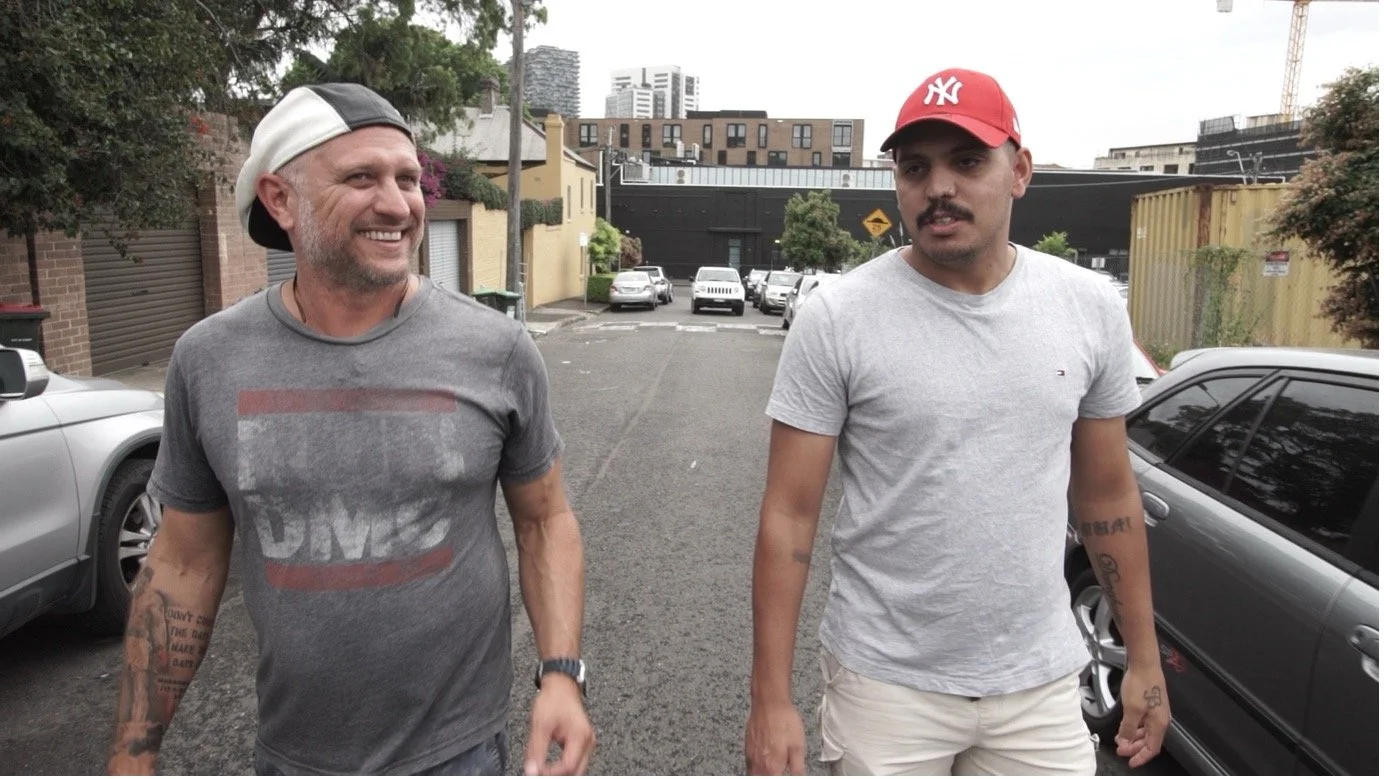
Filmmaker and author Dr Grant Leigh Saunders walking through The Block with MC Sonboy
At the centre of the film is Sonboy, a young Aboriginal MC who grew up on The Block. His track ‘Redfern Hometown’ (2019) isn’t just music - it’s testimony. It’s memory. It’s a direct response to decades of headlines that framed The Block as a problem, rather than a community. A No-Go Zone. “Sydney’s ghetto”.
Through Sonboy, other community members, Hip Hoppers, and activists we see and hear about a different Redfern. Not the “no-go zone” people feared, but a place of kinship. Family on every corner. Kids playing Basketball. People looking out for each other. A community living under pressure - but still holding strong.
A brief socio-political history and cultural significance of The Block
Pre-colonisation, the Gadigal Indigenous people enjoyed a long and continuous occupation of many parts of Sydney, including Redfern, which is located in the centre of Sydney. However, after being dispossessed through British settlement, many Indigenous people returned back to their traditional homelands to find work. In the late 19th century Indigenous people from around the country flocked to Redfern to gain work building the railways. My grandfather and other relatives joined them. According to Anthony (2011), “the population grew to 12,000 by 1965 and Redfern became a home for the Aboriginal Rights Movement” (p. 393). The space the Indigenous people occupied came to be known as “The Block” and was formally established, after much political agitation from Indigenous leaders and non-Indigenous supporters, through a grant by the Whitlam federal government in 1972, that allowed the Aboriginal Housing Company (AHC) to purchase approximately 70 Victorian terrace houses on a block of land bordered by Eveleigh, Caroline, Vine and Louis streets, (Shaw 2000, p. 291). According to McAuliffe (2009), this “was regarded as part of the process of self-determination and reconciliation” and The Block became known as the “symbolic heart of (post)colonial political struggle” (McAuliffe quoted in Anthony 2011, p. 393). The AHC was charged with the responsibility of managing The Block, but according to the current CEO, Uncle Mick Mundine, the AHC has historically not received adequate state or federal government funding to pay for necessary infrastructure and housing upgrades (Mundine in interview 2018).
Consequently, The Block quickly gained a reputation through Australian news media as a “failure”, with the responsibility squarely levelled at the AHC and the Aboriginal people residing there. From the early 80’s through to mid-2000, The Block was often described as Sydney’s “black ghetto”, “spiralling out of control and imploding in a sea of drugs and crime” (Shaw 2000, p. 294). Shaw goes on to recognise that The Block became popularly compared to Harlem, NY:
“It is all too easy to consider the presence of an urban Aboriginal community in Sydney in the same ways. For ‘black ghettos’, failures due to ‘race’ are the common emphases” (Shaw 2000, p. 294).
Like Harlem is to New York, The Block has slowly been affected by Sydney’s gentrification of public housing spaces in Redfern, as well as the neighbouring suburb of Waterloo. As Professor Behrendt (Director of Research at Jumbunna, University of Technology Sydney) notes, the gentrification of Redfern is symptomatic of,
“gentrification all around Sydney in all of the pockets where they have a strong social housing or strong working-class communities” (Behrendt in interview 2018).
Gentrification of The Block has been justified through successfully demonising The Block through sensational news media headlines and non-Aboriginal anti-Block lobby groups (Shaw 2000, p. 301), planned public housing obsolescence (Rogers 2014, p. 119), and finally a state sanctioned privatisation of The Block through the expansion of Sydney City’s urban renewal plans (Rogers 2014, pp. 118-119). Like Harlem, The Block was seen as colonisation’s final frontier (Shaw 2000, p. 296). With the mass exodus of Indigenous people since the early 2000’s, the demolition of public housing to make way for development, the rise in rental prices and the cost of living (Hromek 2016, pp. 6-8) The Block may have since been conquered but the future of The Block is still highly contested.
Regarding its connection to Blak popular culture—particularly African American culture and Hip Hop—Koori Radio, located near The Block in Redfern, has long hosted visiting Black and Indigenous international artists. In 2009, Lauryn Hill and Wyclef Jean of the Fugees performed an impromptu concert at the Sydney University Settlement youth centre (Saunders 2009). Salt-N-Pepa drove down Eveleigh Street handing out free concert tickets; Snoop Dogg met with local residents for photo opportunities (Lucas 2008); Public Enemy visited The Block in the early 1990s (Maxwell 2003); and Michael Franti has been a regular visitor. Other prominent Black cultural figures, including Muhammad Ali and Michael Jackson, also visited Redfern (Morris 2013). These transcultural exchanges continue today, exemplified by Redfern-born Indigenous rapper The Kid Laroi, whose success in the US charts, including collaborations with Juice WRLD, reflects the enduring global reach of Blak Australian Hip Hop.
Alongside these international influences, The Block was also a key site for the emergence of distinctly Aboriginal popular culture from the 1960s onward through institutions such as Black Theatre, the National Aboriginal and Islander Skills Development Association (NAISDA), and Koori Radio. Its connection to Hip Hop emerged from a longer history of African American Black radicalism and Aboriginal political activism, including the influence of Malcolm X, Louis Farrakhan, and Marcus Garvey on Aboriginal activists such as Gary Foley, Dennis Walker, and earlier figures like Fred Maynard. Musically, political expressions of Black pride and resistance through reggae, soul, and funk—particularly artists such as Bob Marley, James Brown, Gil Scott-Heron, and Marvin Gaye—laid the groundwork for Aboriginal engagement with Hip Hop. This intensified with the release of The Message by Grand Master Flash and later Fuck Da Police by N.W.A., whose themes of poverty, police harassment, racism, and resistance resonated strongly with Aboriginal youth in marginalised urban communities such as The Block. This resonance contributed to the emergence of local Hip Hop acts including South West Syndicate, Brotha Black, MC Wire, and Street Warriors (Morgan 2015, p. 216).
Today, Aboriginal Hip Hop maintains a strong national presence through artists including Briggs, A.B. Original, Barkaa, DOBBY, The Last Kinection, Yung Warriors, Nooky, Ziggy Ramo, JK-47, Jimblah, Dallas Woods, Baker Boy, Mau Power, Tasman Keith, and Birdz. Their visibility has been significantly supported by Triple J, particularly through its Hip Hop program hosted by Maya Jupiter (2004–2008) and Hau Latukefu (2008–2022), both of whom championed First Nations and other marginalised voices in Australian Hip Hop. Revolving hosts of the Hip Hop show continue this legacy, promoting the works of emerging and established Indigenous and other culturally and racially marginalised artists.
In the film, Sonboy walks toward camera, rapping ‘Redfern Hometown’ against the backdrop of the Aboriginal flag mural - one of the last visual markers of Blak Redfern at the time.
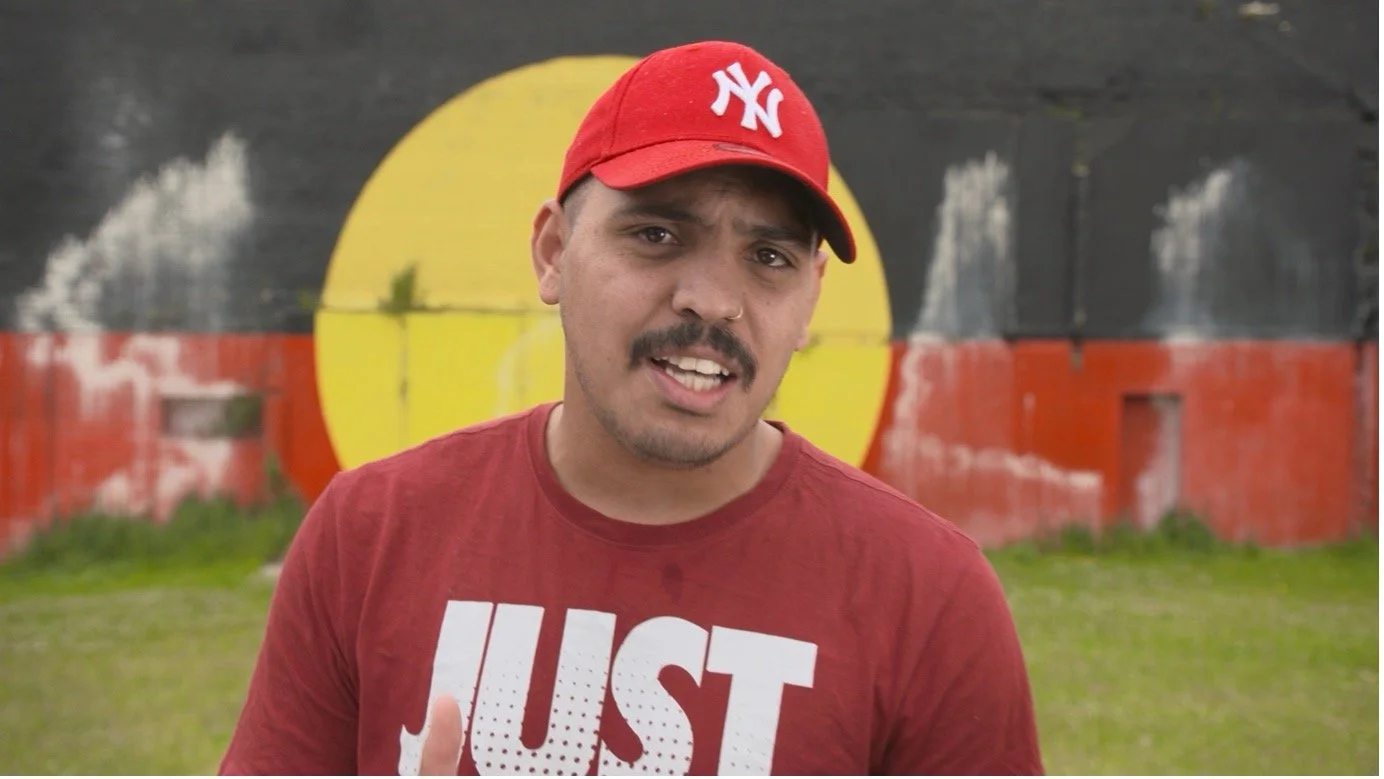
MC Sonboy rapping to camera in front of old Aboriginal flag mural. Still image from yet to be released film ‘Hip Hop and The Block’.
That mural is now gone with the demolition of the equally iconic Mundine’s Gym, that provided the brick wall for the mural, where Muhammad Ali once visited and Australia’s own boxing champion Anthony Mundine trained.
The erasure of The Block, and the disappearing of its original residents, its history and its significance to the Blak resistance movement and rise of Blak popular culture in so-called ‘Australia’ is the main point of the film.
Because what’s happened in Redfern isn’t just redevelopment - it’s displacement, again. The Block, once the “black heart of Sydney,” has been dismantled through planned obsolescence, gentrification, urban renewal policy, and a deliberate deficit narrative.
But this film doesn’t speak in policy language.
It speaks through Sonboy, Hip Hop and those with their own special connection to the original Block.
Through Sonboy’s music, we move between what Redfern was and what it has become. His lyrics carry stories of police surveillance, harassment, exclusion, and growing up in a place outsiders avoided - while also holding onto what they never saw: love, culture, and belonging.
This is what the film captures - a lived reality that sits in tension with the official story.
And that tension matters.
Because ‘Hip Hop and The Block’ isn’t just a documentary - it’s an intervention. It uses Hip Hop as a lens to unpack the social justice issues shaping Aboriginal lives today, from policing to housing to the right to an urban life on Country.
Right now, the film is in post-production.
After years of work, it’s close - but not finished.
The project has currently raised $18,264 of its $50,000 goal, with support from 74 backers. To complete the film - including archive licensing, music rights, and final postproduction - more support is needed.
And this part matters just as much as the film itself:
If this story doesn’t get finished, it doesn’t get seen.
If it doesn’t get seen, the dominant narrative about places like The Block continue unchecked.
Your support isn’t just funding a film - it’s backing a story that challenges how Australia understands its own cities, its own history, and its own people.
It’s also directly supporting artists like Sonboy, whose music - and whose story - sit at the core of this film’s impact.
If this resonates with you, contribute here:
👉 Documentary Australia Foundation project page:
https://documentaryaustralia.com.au/project/justus-hip-hop-and-the-block/
Help get this film finished.
Help get it seen.
Help make sure The Block is remembered - on its own terms.
Bio: Dr Grant Leigh Saunders is a filmmaker and research scholar who graduated from the Australian Film Television and Radio School with an MA (Honours) in Documentary. He produced over 20 documentaries for ABC’s Message Stick, alongside music videos and short-form content. His online sketch comedy series ‘WhiteBlackAtcha’ led to an ABC commission for ‘Black Santa’ (2013). He later produced ‘A Flash Black? The Michael McLeod Story’ (2016) for National Indigenous Television (NITV) and co-produced the feature documentary ‘Teach a Man to Fish’, a finalist for best documentary at both the Sydney International and Byron Bay International Film festivals and commissioned for NITV in 2018. Saunders holds a Doctor of Creative Arts from the University of Technology Sydney and is currently lecturing in Indigenous Studies and Blak popular culture at the University of New South Wales.
Attribution: Saunders, G.L. (2026). The Bloc, Breadfern, ‘Hip Hop and The Block’. Beats + Bass Cultures Network. https://beatsnbasscultures.org/new-blog-1/the-bloc-breadfern-hip-hop-and-the-block-saunders