Network Founder Introduction: Di Rodger

Who are you and what’s your connection to Beats + Bass Cultures?
My name is Di and I am a Hip Hop fan and researcher who works as a lecturer in anthropology at Adelaide University. My connection to Beats and Bass Cultures is mainly through Hip Hop. My early memories of Hip Hop come from being a child growing up in regional Victoria in the 1990s, when Hip Hop was one genre among many heard across the primary school ground. Probably inappropriately, Shoop by Salt n’ Pepa was a favourite of mine. Another entry point was the stereotypical ‘end credit’ rap song that was a fixture of 1990s family movies like Vanilla Ice’s Ninja Rap. It wasn’t until high school that I started to learn more about Hip Hop music and then Hip Hop as a culture, through friends, programs like RAGE and the early web. I would watch music video clips and write down names of songs and artists to check out. This was the Napster era when illegal downloading was a way to try new music (which led to new fans for musicians but of course impacted their income). Stumbling across the supergroup Deltron 3030 was life changing and introduced me to many of my favourite artists to this day.
When I turned 18 and moved to Adelaide for University, I was able to go to more events and see local MCs, DJs, Breakers and sometimes Graffiti Writers as support acts. Records stores, street press and Hip Hop media were also huge sites of learning. Shout out to the Beat Moochers crew for sharing good times and tunes. Hip Hop was also one of the early sparks with my boyfriend at the time (and now husband) Adam.
During University, my studies in anthropology gave me new insights into how people create worlds that are meaningful to them. After finishing a Bachelor of Arts degree in 2004, I decided to give an Honours year a go and wrote a thesis about how Hip Hop is localised when it is adopted by people outside of the Bronx. I was inspired by anthropologists working in the department at then University of Adelaide, and by the work of authors like Ian Condry (Hip-Hop Japan: Rap and the Paths of Cultural Globalization) and Ian Maxwell (Phat Beats, Dope Rhymes: Hip Hop Down Under Comin' Upper). My Honours project was a desk-based one, so when I got the opportunity to do a PhD (a 3-4 year full time research project) I wanted to spend more time with people who made up the Hip Hop scene in Adelaide (with some time in Melbourne) and explore why it was such an important part of their lives.
Since then, I have used my training in anthropology to work on different research projects, but I always try to find a way to come back to Hip Hop! As I get older, one of the things I am interested in is how people’s engagements with Hip Hop shift over time and how they make space (or not) for it when their circumstances change – like navigating work challenges or parenting. This interest in life histories and memory connects to a recent project that I led called the ‘South Australian Hip Hop Digital Archive’ that was funded by the History Trust of South Australia in partnership with Derek ‘Madcap’ and Anthony ‘Lewps’. Keep an eye on this blog for a post about this project!
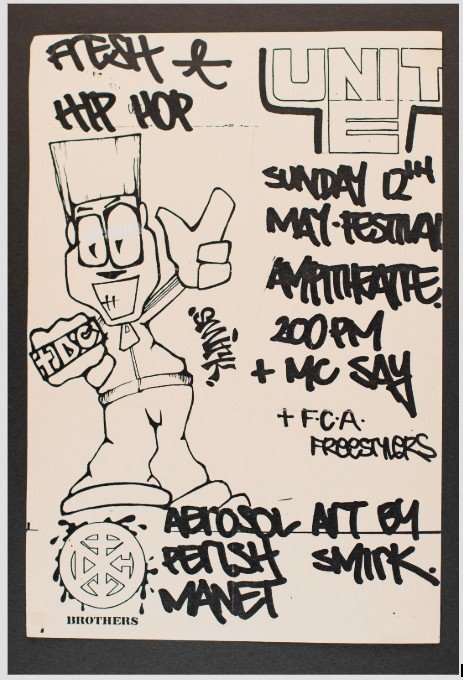
Unit-E event flyer from 1991 show at the Festival Ampitheatre, Adelaide. Presented by Come Out Festival and Unit-E. Copyright holders: Ben Tan, Derek Downing, Sam Osborne.
Why are you part of the Beats + Bass Network and what do you hope it achieves?
I’m part of this network because I have seen first-hand the power of the art, music, dance, knowledges and communities made by people through Beats + Bass cultures. I want to be part of a network that amplifies and celebrates this, creating opportunities to share ideas, expertise, wins, and challenges. As hinted at by ‘challenges’, this doesn’t mean romanticising these complex cultural movements but making space for thoughtful reflection.
I am excited about meeting new people who are passionate about Beats + Bass Cultures and using the network to feature stories from contributors who might not always be in the same rooms together. Thinking critically about whose experiences and knowledges are centered and in what format is important. While digital media platforms shouldn’t be seen as a simplistic answer to complex questions about social justice, access and inclusion – it is useful to keep thinking about how digital tools can be used to challenge systems of oppression and create sites of connection.
This work is licensed under CC BY-NC-SA 4.0
Attribution: Rodger, D. (2026). Network Founder Introductions: Di Rodger. Beats + Bass Cultures Network. https://beatsnbasscultures.org/new-blog-1/network-founder-introductions-di-rodger